Roman Curia
The DecameronThe Roman Curia appears in the Decameron as the papal court Abraham visits to judge whether Christianity deserves his allegiance. His inspection yields a scathing picture of clerical vice, but its decisive effect is paradoxical: convinced that the faith survives despite its leaders, Abraham chooses conversion. The episode turns an institutional indictment into an argument for divine providence.
The court as a test of faith
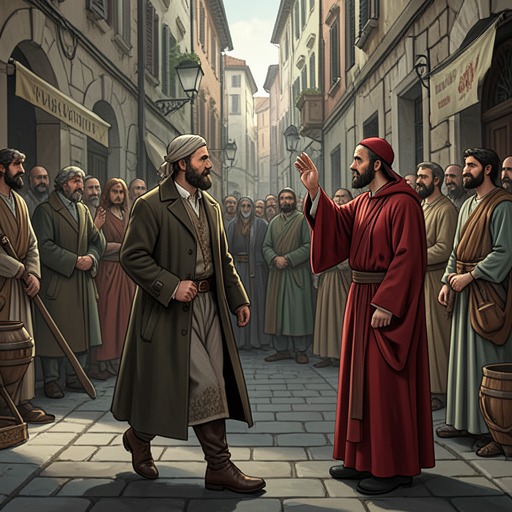
Abraham, a Jewish merchant and friend of Jehannot de Chevigné, agrees to consider conversion but insists on seeing the Pope and the senior clergy in Rome for himself. He will decide by their conduct, not merely by Jehannot’s arguments. Jehannot understands the risk: he expects that a direct encounter with the court’s reputation and behavior will drive Abraham away from Christianity, and warns that the journey is dangerous and unnecessary. Abraham remains determined, making the Roman Curia the test he has chosen for the claims of the religion it represents.
The story introduces that test within a broader reflection on divine mercy. Its narrator has just argued that God may hear prayers offered through an intercessor whom people mistakenly believe to be holy; the argument distinguishes human judgment from what is hidden in God’s purposes. Abraham’s visit develops a related problem from the opposite direction: the failings of churchmen are visible, yet they do not settle the truth of the faith.
Abraham’s inspection of the clergy
At the Roman court, Abraham quietly observes the Pope, cardinals, prelates, and other members of the household, supplementing what he sees with what he learns from others. The account presents his judgment as an inquiry across ranks, from the highest to the lowest, rather than as a response to one isolated encounter. He finds, as the story tells it, that the clergy are given to lust, including sexual conduct described as both natural and sodomitical, without apparent restraint or shame.
He also sees gluttony and drunkenness treated as habitual indulgence. The clergy, in his assessment, serve their appetites more readily than any spiritual purpose. His attention then turns from private conduct to the handling of money and sacred offices: he judges the court covetous, and says that church benefices, sacred things, and even human and Christian blood are bought and sold. The image is of a religious institution in which spiritual authority and material exchange have become entangled.
The story sharpens its criticism by emphasizing the language used to disguise wrongdoing. Simony, the buying and selling of ecclesiastical things, is called procuration; gluttony is called sustentation. These euphemisms do not change the acts, Abraham reasons, and cannot conceal corrupt intentions from God. The court’s failure is therefore not only that its members sin, but that they give vice respectable names while occupying offices that should testify to the faith.
The paradox of conversion
Abraham returns to Paris deeply displeased by what he has witnessed. When Jehannot asks what he made of the Pope, the cardinals, and their court, Abraham condemns their lack of piety, devotion, good works, and exemplary conduct. He goes so far as to describe the court as a forge of diabolical rather than divine things. His verdict is not softened by the institution’s rank: he believes that its leaders and their subordinates strive, with all their skill, to undermine Christianity.
Yet this judgment produces the reverse of the outcome Jehannot feared. Abraham reasons that if the clergy really sought to destroy their religion, Christianity should not continue to grow and flourish. Its persistence in spite of the conduct of those who ought to be its foundation and support convinces him that the Holy Spirit must sustain it. The Curia’s corruption thus becomes, in the logic of the tale, an unwitting demonstration that the faith cannot depend solely on the virtue of its human representatives.
Narrative significance
Jehannot accompanies Abraham to the Church of Our Lady of Paris, where Abraham is baptized and given the name Giovanni. Jehannot raises him from the baptismal font; Abraham is then taught the tenets of the faith and is described as becoming a good, worthy, and devout man. The ending makes the contrast with the Roman court especially pointed: the institution’s example fails, but Abraham’s scrutiny ends in sincere religious commitment.
The episode is a satirical account of clerical hypocrisy, not a neutral description of administrative structure. Its method is to let a prospective convert judge the court by the standards Christianity itself professes, then turn his severe findings into a theological paradox. The Roman Curia appears at once as a scandalous institution and as the setting for a story arguing that divine truth may endure independently of the conduct of its custodians.